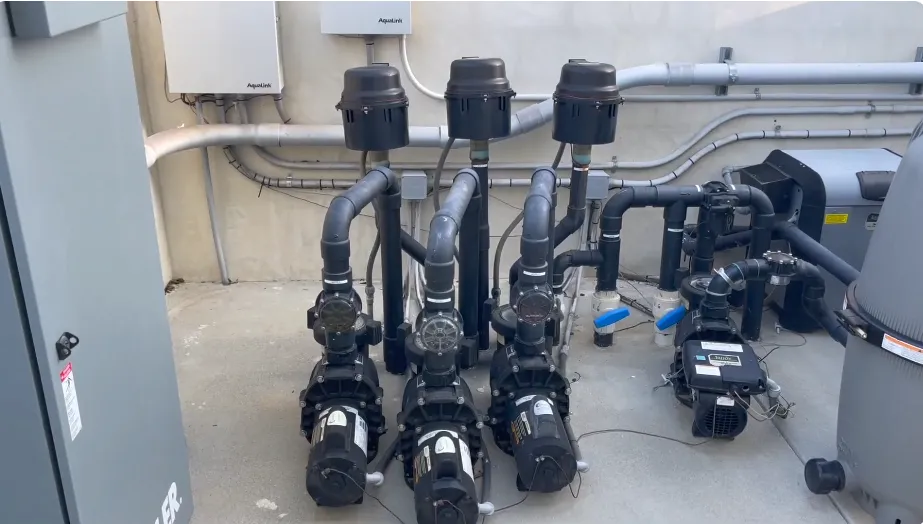
Pool equipment pad leaks most often come from the pump lid O-ring, the pump shaft seal, threaded fittings at the pump, a filter tank or its multiport valve, the heater's connections or heat exchanger, and diverter valves. Look for water under the equipment while it runs, then again while it is off, to separate pressure-side leaks from suction-side ones.
- Check the pad with the pump running and again with it off.
- A worn shaft seal often drips under the pump motor.
- Air in the pump basket points to a suction-side leak.
- Sun and heat age O-rings and fittings faster in Florida.
The Pump
Lid O-ring. A dry or cracked O-ring lets air in and water out around the basket lid.
Shaft seal. Water dripping from between the pump and motor usually means a worn shaft seal. Left alone, it can damage the motor bearings.
Fittings. Threaded fittings in and out of the pump can crack, especially after over-tightening or years of heat.
The Filter
Look at the tank body, the drain plug, the pressure gauge port and the band clamp. On sand filters, a multiport valve with a worn gasket can push water out of the backwash line all the time. If water keeps trickling from the backwash outlet when the valve is on filter, the gasket is likely the cause.
Heaters and Heat Pumps
Heater connections and heat exchangers can leak, especially with poor water chemistry. Heat pumps also make condensate while running, which is normal and looks like a leak. Condensate stops when the unit is off; a true leak does not.
Valves and Lines
Diverter valves, check valves and the lines between them can leak at their bodies and joints. Above-ground PVC exposed to Plant City sun becomes brittle over time. Wet soil where lines go into the ground can mean a leak just below the surface.
How to Check the Pad
- With the pump running, look for spraying, dripping or wet spots under each piece of equipment.
- Turn the pump off and check again. Suction-side leaks may only drip when the system is off.
- Look in the pump basket while running: air bubbles suggest air is being pulled in on the suction side.
- Dry the pad and lay paper towels under suspect fittings, then check them later.
If the pad is dry but the pool still loses water, run a bucket test and consider pressure testing the plumbing.
When to Call
Simple O-rings and gaskets are often easy fixes. Leaks inside heaters, at buried fittings or in the lines between the pool and the pad need professional testing. See pool leak detection.
Frequently Asked Questions
Why is water dripping under my pool pump?
A worn shaft seal is a common cause, as are cracked fittings at the pump.
Is water from my heat pump a leak?
Heat pumps make condensate while running. If it stops when the unit is off, it is normal.
Can an equipment leak drain my pool?
A pressure-side leak can lose a lot of water while the pump runs, and the autofill may hide it.
What causes air in the pump basket?
Air is usually pulled in through a suction-side leak, such as the lid O-ring or a fitting before the pump.
How do I get a quote?
Call (813) 303-9621, describe where the pad is wet, and a local provider can give you a free quote for testing.